A delayed lighting package can stall drywall closeout, push inspections, and turn a clean schedule into a costly scramble. That is why choosing the best quick ship lighting for builder projects is less about chasing a trendy fixture and more about protecting timeline, labor efficiency, and resale appeal at the same time.
For builders, designers, and investors, quick ship only works when the product is actually spec-safe. Fast delivery means very little if the fixture arrives with odd mounting requirements, inconsistent finishes, or light output that makes a fresh renovation look flat. The better approach is to treat lighting as a build decision, not a last-minute décor add-on.
What the best quick ship lighting for builder projects really needs to do
In builder work, speed matters, but speed by itself is not the goal. The fixture has to install cleanly, fit common junction box conditions, and work across multiple room types without creating a fragmented look. That is where many projects lose money. A fixture may be available in 48 hours, but if it demands extra assembly, special bulbs, or return visits for replacement parts, the “quick ship” advantage disappears.
The strongest quick ship lighting programs usually share a few traits. They carry repeatable SKUs, standard finishes, and dimensions that fit production framing realities. They also balance design neutrality with enough style to support listing photos, model units, or a client-facing spec package.
For most builder-grade and mid-market projects, the sweet spot is a fixture family that looks current without reading overly custom. Think simple dome flush mounts, low-profile semi-flush fixtures, clean-lined vanity lights, basic chandeliers with updated finishes, and pendants that can scale from spec homes to light commercial common areas.
Why it stands out when the spec is simple
The best-performing lighting packages are usually the easiest to repeat. Builders working across subdivisions, multifamily turnovers, or flips benefit from standardization because it reduces ordering errors and shortens install decisions in the field.
A simple spec also improves substitution flexibility. If one 3-light vanity goes out of stock, it is easier to swap within the same family or finish category without redesigning the room. That matters for investors trying to hit a listing date and for designers who need a polished result without restarting approvals.
There is a trade-off, of course. Over-standardizing can make a project feel generic, especially in competitive resale markets. The fix is not to make every room different. It is to choose one or two visible upgrade moments, usually the entry, dining area, kitchen island, or primary bath, while keeping secondary spaces efficient.
The fixture types worth prioritizing
Flush and semi-flush ceiling lights
These are the backbone of quick ship builder lighting. They solve for bedrooms, hallways, laundry rooms, closets, and lower ceilings with minimal field issues. Look for fixtures with integrated LED when maintenance consistency matters, but do not assume integrated LED is always the better call.
For rentals and heavy-turn environments, integrated LED can reduce bulb replacement complaints. For long-hold residential projects, replaceable-bulb fixtures may be easier to maintain over time if an LED board fails years later. It depends on whether your priority is short-term labor savings or long-term serviceability.
Vanity lighting
Bathroom vanity lights do more work than they get credit for. They affect mirror visibility, perceived cleanliness, and the finish quality of the entire bath. A fast-shipping vanity bar in black, brushed nickel, or warm brass can elevate a basic bathroom with very little budget impact.
This is one of the best places to avoid underpowered fixtures. Buyers notice bad bathroom lighting immediately, and staging photos suffer when light is harsh or uneven. Aim for practical output and a scale that fits the mirror, not just the electrical rough-in.
Pendants for kitchens and islands
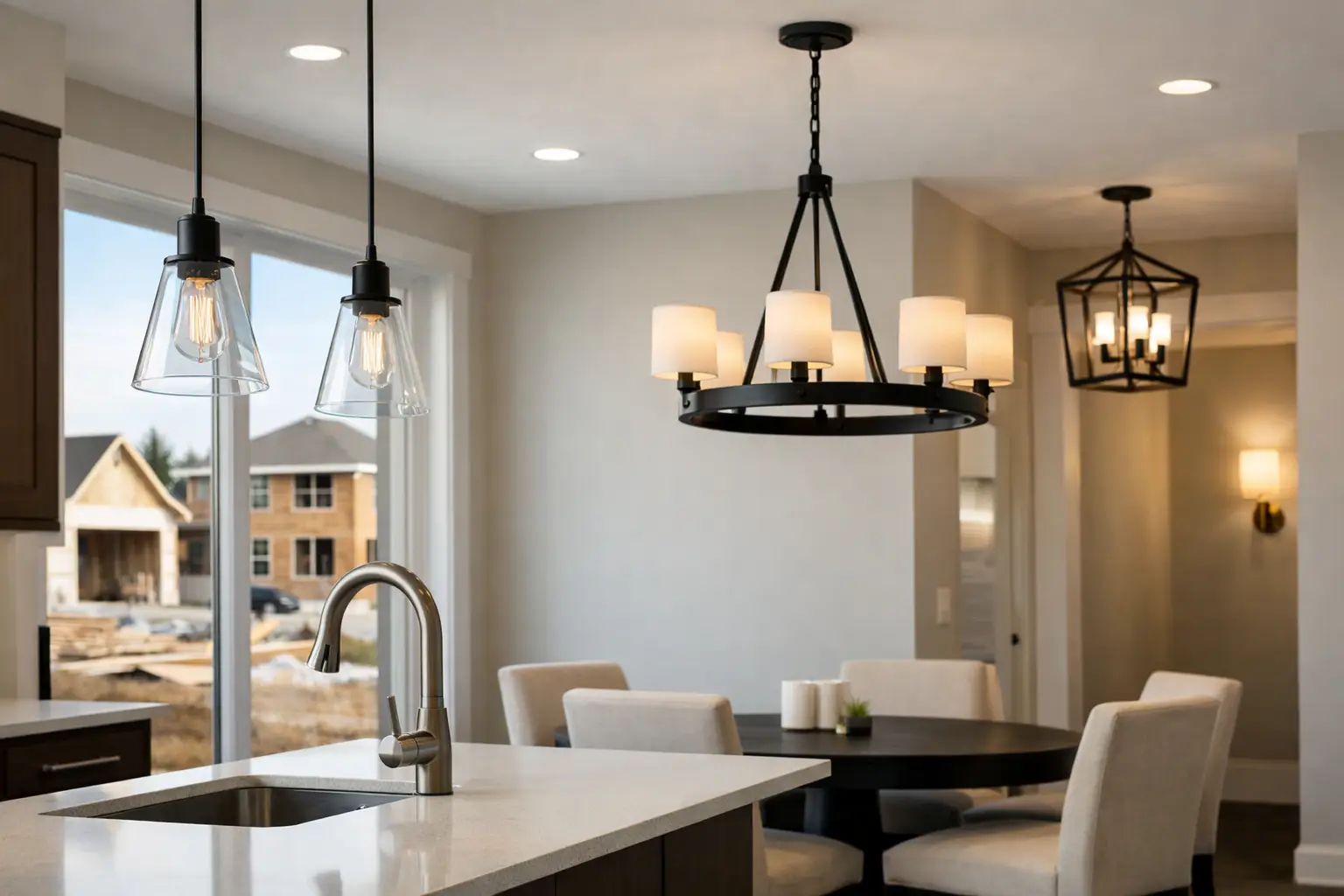
If there is one lighting category that can make a spec kitchen feel intentional, it is pendants. Quick ship pendants work best when the shape is clean and the glass or metal finish is easy to match with hardware and faucets.
The caution here is lead time creep through customization. A standard pendant in a stocked finish is a quick ship product. A pendant with custom rods, special glass, or a niche finish often is not. Builders should treat kitchen pendants as controlled upgrades, not open-ended design exercises.
Dining and foyer fixtures
These are the visual anchors that help a project photograph above its price band. For flips and speculative builds, a well-scaled chandelier or linear fixture in the dining area can improve perceived value without requiring major electrical changes.
That said, these pieces should still install simply. Avoid fixtures with excessive crystal assembly, fragile components, or dimensions that create freight risk. The best builder-friendly statement piece is one electrician can hang without losing half a day.
Builder lighting trends that move product, not just pictures
Current builder lighting trends favor cleaner silhouettes, warmer metals, and fixtures that bridge modern and transitional styles. Matte black remains useful because it is easy to coordinate and hides minor wear well. Brushed gold and soft brass are still strong in higher-end specs, especially when used selectively rather than throughout the entire property.
Milk glass, opal glass, and textured clear glass continue to perform because they soften light and photograph well. In investor projects, these finishes can make inexpensive spaces feel more considered. In designer-led projects, they add enough character without slowing approvals.
Size has shifted too. Underscaled fixtures make new renovations feel cautious and dated. Overscaled fixtures can create clearance and proportion issues. The practical move is to go slightly larger in public rooms and stay disciplined in bedrooms, corridors, and utility zones.
How to evaluate quick ship options before you place the order
Start with install logic. Check canopy size, fixture weight, rod or chain adjustability, and whether bulbs are included. Then check the finish consistency across the line. A lighting family that offers matching flush mount, vanity, pendant, and chandelier options gives you flexibility if the room plan changes.
Next, think about damage risk and replacement speed. Glass-heavy fixtures may look strong in a showroom photo, but they can create field delays if one shade arrives broken and the replacement process drags. For tight timelines, simpler construction often wins.
Photometrics and color temperature matter more than many project teams expect. If possible, stay in a warm, market-friendly range that flatters flooring, paint, and skin tone. Lighting that is too cool can make a renovated home feel sterile, especially in flips staged for broad buyer appeal.
Finally, check carton dimensions and inventory depth if you are buying at scale. Quick ship for one fixture is not the same as quick ship for 40 units across multiple buildings.
Sourcing strategy for pros who cannot afford rework
The smartest sourcing decision is usually not the cheapest unit cost. It is the vendor or program that can keep your package consistent across phases, replacements, and late adds. Builders know this already from flooring and plumbing. Lighting deserves the same discipline.
A dependable trade source can help you avoid mixed dye lots in finishes, mismatched glass, and the common headache of spec drift between model unit and production unit. That is especially useful for designers who need a cohesive look and for investors trying to standardize across multiple properties.
This is also where local or trade-focused buying channels can outperform random online ordering. If the source understands builder schedules, they can often flag stock risk before it becomes a site problem. For teams looking to compare practical fixture options and trade-focused design insights, Hudson Valley Review can be a useful starting point.
Where to spend a little more and where to stay lean
Not every room deserves the same lighting budget. Public-facing areas should carry more of the visual weight because that is where buyers, tenants, and clients form their first impression. Entry fixtures, kitchen pendants, dining chandeliers, and primary bath vanity lights usually justify a moderate upgrade.
Secondary bedrooms, halls, closets, and utility spaces are where repeatable quick ship basics earn their keep. The goal is not to cheap out. The goal is to preserve budget for the places that influence offer strength, lease velocity, or client satisfaction.
If you are building in a highly competitive resale pocket, one strong decorative moment can lift the perceived finish level of the whole project. If you are working on a rental or entry-level production home, reliability and replacement ease may matter more than design distinction. It depends on exit strategy.
A practical spec approach that saves time
For most builder projects, a tight lighting package can follow a simple structure: one finish family across the home, one decorative language for visible rooms, and one highly repeatable utility fixture for secondary spaces. That keeps purchasing clean, install training minimal, and substitutions manageable.
Designers can still create contrast through scale, shade shape, and room placement. Builders get fewer field questions. Investors get a better-looking product without slowing the turn. That is the kind of decision that protects both margin and marketability.
The right fixture is not the one that ships fastest on paper. It is the one that arrives on time, installs without drama, and makes the property look finished the first time the lights turn on. Spec that standard for your next project, and the schedule usually gets easier from there.







Leave a Reply