You can spot a spec that will bite you later from across a jobsite. A builder-grade fan that hums at low speed, wobbles after one season, or draws more power than it needs is a small line item that quietly drags down perceived quality. On flips and rentals, it shows up as buyer objections and maintenance calls. On custom builds, it shows up as design compromises and client frustration.
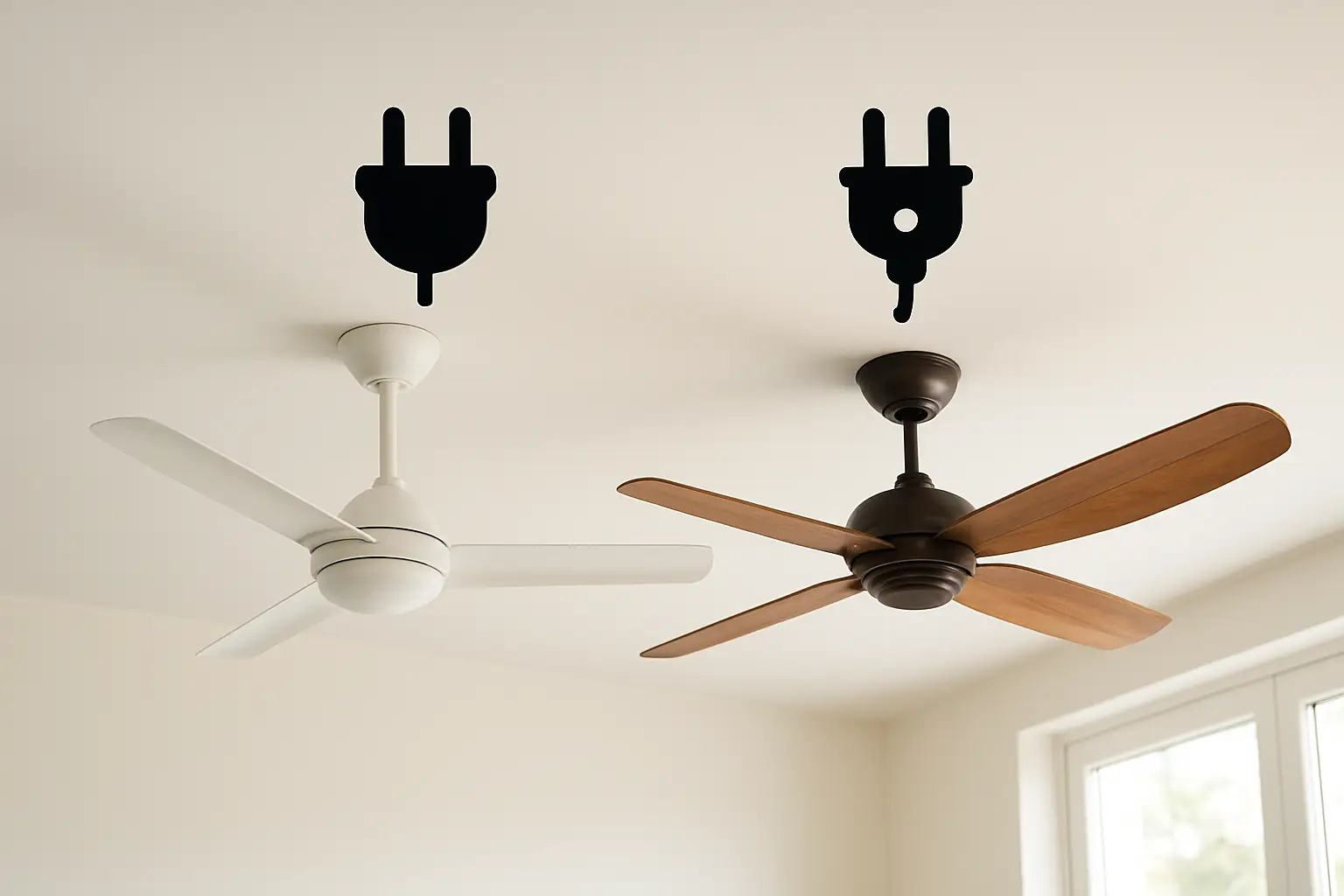
That is why the conversation around dc motor vs ac motor ceiling fan efficiency is worth having with your team. The “efficient” choice is not always the same fan for every room. It is the fan that hits airflow targets, control expectations, and reliability with the least total cost over the project lifecycle.
What “efficiency” means on a ceiling fan spec
Most pros start with watts, and that is fair. Lower watt draw for similar airflow is real savings, especially on multi-unit projects or portfolios where you pay the utilities between turns.
But on ceiling fans, efficiency is better understood as a three-part equation: airflow delivered (CFM), power consumed (watts), and usability (how often occupants actually run it at the setting that works). A fan that is technically efficient but annoying to control often ends up off, then the HVAC works harder. A fan that moves air well at low speed can make a room feel 3-4 degrees cooler and keep occupants comfortable without touching the thermostat.
The metric you want is typically CFM per watt. Higher is better. You will see DC-motor fans win this comparison in most modern product lines, but there are trade-offs that matter on real projects.
DC motor vs AC motor ceiling fan efficiency: what changes mechanically
AC (alternating current) motors are the traditional ceiling fan motor type. They are proven, widely available, and typically priced lower. They commonly use capacitor-based speed control with a few fixed speeds.
DC (direct current) motor fans convert incoming AC power to DC using onboard electronics. That conversion enables more precise motor control and usually reduces energy losses at the motor. In practice, that is why DC fans often deliver similar airflow at significantly lower wattage, especially at low and medium speeds where fans spend most of their life.
That electronic control also changes the user experience: DC fans tend to start smoother, run quieter, and offer more speeds. For bedrooms, offices, and high-end living spaces, those “soft” performance benefits often matter as much as the electric bill.
Where DC ceiling fans deliver real efficiency gains
The best way to think about DC efficiency is not as a lab number, but as a performance advantage you can deploy where it impacts comfort and operating cost.
First, DC fans typically draw fewer watts to maintain steady rotation. In many comparable 52-inch fans, an AC motor might pull meaningfully more power at medium speed than a DC counterpart pushing similar air. Multiply that across a 10-unit build, then across years of occupant use, and you get a measurable operating-cost edge.
Second, DC fans tend to be more efficient at lower speeds. That matters because most occupants do not run ceiling fans at full blast all day. They set a comfortable low-to-medium speed and leave it there. If your fan spec performs well in that range, you get comfort with minimal energy use, and fewer noise complaints.
Third, DC control can help you “right-size” comfort. With more speed steps, occupants can fine-tune airflow instead of toggling between three speeds that feel like too little, too much, and hurricane. The practical outcome is more consistent use, which supports HVAC setpoints and comfort.
Where AC fans still win the project (and the budget)
Efficiency is not the only KPI on a build. AC fans keep showing up on scopes for good reasons.
If you are outfitting a large number of units at a tight price point, AC motor fans can still pencil out. The upfront delta between AC and DC can outweigh utility savings, particularly where tenants pay their own electric and the owner is focused on CapEx.
AC fans also tend to be simpler electrically. Fewer onboard electronics can mean fewer failure modes in harsh environments, though quality varies more by manufacturer than motor type. For contractor-grade reliability, you still want solid balancing, good bearings, and a clean mounting system.
Then there is controls compatibility. Many AC fans pair cleanly with wall controls already common in multifamily work, and they can integrate with basic fan-rated switches. That can reduce install complexity and post-close support.
Controls and commissioning: the hidden efficiency line item
This is where a lot of projects lose time.
Many DC fans ship with a remote receiver and expect remote control out of the box. That can be a win in spaces where wall boxes are limited or design calls for a clean switchbank. It can also become a headache if the client expects a standard wall control feel, if remotes get lost in rentals, or if the property manager wants standardized controls across units.
AC fans more often support traditional wall control setups, although plenty of AC models also include remotes.
The spec move that protects your schedule is to decide early:
Are you delivering wall control, remote control, smart control, or a hybrid? And who will support it when the occupant moves in?
If you pick DC for efficiency, consider pairing it with a wall control solution that keeps the user experience consistent. That is not just a comfort decision. It reduces call-backs, which is real project cost.
Airflow, blade design, and why motor type is only half the story
A DC motor can be efficient and still underperform if the blade pitch, span, and housing design are wrong for the room. Likewise, an AC fan with strong aerodynamics can beat a cheap DC fan in actual delivered comfort.
For pros, the faster filter is to spec to the room volume and ceiling height:
In standard 8-9 foot ceilings, you want a fan that delivers usable airflow at low speed without feeling like a wind tunnel. In great rooms and vaulted spaces, you need blade span and downrod length that put airflow where people live, not trapped at the peak.
Efficiency shows up when occupants can run the fan slower because the fan is correctly sized and placed. That is why CFM per watt matters, but so does the fan’s ability to distribute air evenly without noise.
Noise and perceived quality: efficiency’s impact on ROI
Noise is one of the most underrated ROI drivers in fan specs. A fan that clicks, hums, or motor-whines on low speed will get turned off. Then your “efficient” system becomes theoretical.
DC fans generally have an edge here due to their control characteristics and smoother operation. In bedrooms, nurseries, and work-from-home spaces, that can be the difference between a five-star review and a complaint.
For flips, perceived quality sells. A quiet, stable fan reads as “new build quality,” especially when paired with updated lighting. That buyer impression can justify a slightly higher list price or reduce negotiation friction.
The spec decision framework (fast, practical, repeatable)
If you are deciding room by room, here is the simplest way to choose without overthinking it.
Use DC fans where comfort precision and quiet operation are part of the value proposition: primary bedrooms, home offices, living rooms in higher-end renos, and any space where the client will notice motor noise. If the home is being marketed as energy-aware or tech-forward, DC aligns with that story.
Use AC fans where standardization, upfront cost, and straightforward controls matter most: secondary bedrooms in budget scopes, garages, covered patios (with the correct damp or wet rating), and high-volume unit turns where you want predictable install and easy replacement.
Then sanity-check the control plan. If the property manager hates remotes, do not spec a remote-first DC fan unless you have a wall control strategy. If the designer is pushing for clean walls with minimal switches, a DC fan with remote or smart control can be a clean solution.
What to ask suppliers so you do not get burned
Even good-looking submittals can hide pain. Ask for tested airflow and power data, and confirm the warranty terms that matter to your use case.
You also want to verify what is included in the box: downrods, adapters for angled ceilings, and the control hardware. A “great price” fan that requires extra parts and extra trips stops being a deal fast.
For trade partners and spec support, this is where working with a source that understands pro workflows saves time. If you are building a repeatable fan package across projects, a single point of contact who can keep finish continuity and availability is worth more than shaving a few dollars per unit.
The bottom line for project efficiency
DC wins the efficiency conversation most of the time in pure performance per watt, and it often wins on noise and control finesse. AC still earns its place where budget, simplicity, and standardized controls are the priority.
If you want the decision to pay off, treat the fan like a system: motor type, blade design, room size, mounting height, and controls. Spec it that way, and you will cut energy waste, reduce call-backs, and deliver a finished space that feels intentionally built.
For more spec-forward lighting and fan guidance aimed at builders, designers, and investors, keep an eye on insights from Hudson Valley Review.
The next time a ceiling fan shows up as a throwaway line item, use it as a quiet differentiator instead: the kind of practical upgrade that occupants feel every day, and that your team does not have to revisit after close.








Leave a Reply