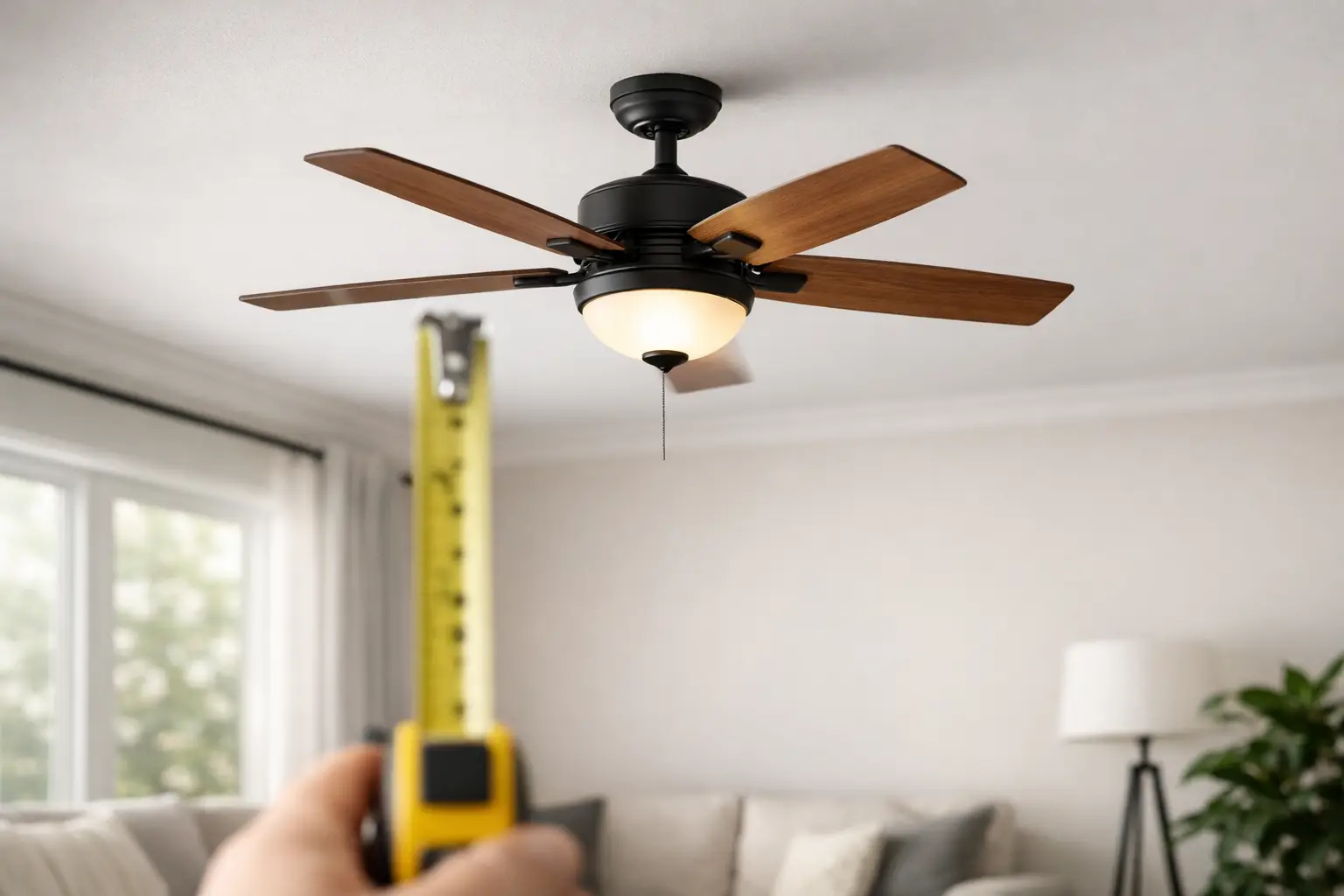
A ceiling fan that hangs 6 inches too low can turn a clean install into a punch-list problem. It affects safety, airflow, buyer perception, and in some cases whether the room feels professionally finished at all. So if you’re asking what is the ideal ceiling fan height clearance, the short answer is this: the fan blades should sit at least 7 feet above the finished floor, and the sweet spot for performance is usually 8 to 9 feet above the floor.
That baseline matters whether you’re finishing a spec home, updating a rental, or selecting fixtures for a client-facing remodel. Ceiling fans are one of those details that look simple until the room proportions, ceiling slope, or staging plan force a compromise. Get the height right, and the fan works harder while looking intentional. Get it wrong, and you create install delays, code concerns, or a room that feels visually off.
What is the ideal ceiling fan height clearance in real projects?
For most residential installs, the minimum safe clearance is 7 feet from the floor to the lowest point of the fan blades. That is the threshold many electricians and inspectors use as the non-negotiable starting point. But minimum safe and ideal are not the same thing.
In practice, 8 to 9 feet from the floor to the blades is the better target. That range usually gives you stronger air distribution, cleaner sightlines, and a more proportional look in standard living rooms, bedrooms, and open-plan spaces. Builders and designers care about this because fan placement changes how a room reads. A fan pressed too close to the ceiling can look undersized and underpowered. A fan dropped too far can dominate the room and create clearance issues over beds, islands, or circulation paths.
The other side of the equation is top clearance. Most manufacturers want at least 8 to 10 inches between the ceiling and the blade tips for proper airflow. Too tight, and the fan struggles to pull and move air efficiently. That means a low-profile fan is not automatically the right answer for every 8-foot room. You still need enough space above the blades for the fan to perform.
Why this clearance affects more than safety
Pros tend to think about ceiling fan height as a code box to check. It is that, but it also affects comfort, energy use, and resale presentation.
First is airflow. Ceiling fans need room to circulate air in a full pattern. When the blades sit too high, especially in taller rooms, the airflow can dissipate before it reaches the occupied zone. When the blades sit too low, the fan can create uncomfortable direct drafts and visual clutter. The 8- to 9-foot blade height often lands in the best functional zone for occupied spaces.
Second is aesthetics. In flips and staged listings, buyers notice proportion even if they cannot name it. A fan at the wrong height can make a room feel shorter, busier, or poorly planned. In designer-led projects, that matters even more. A good fan should feel integrated with the architecture, not like an afterthought added to satisfy a feature list.
Third is install efficiency. Choosing the right mounting style up front avoids return trips. If the ceiling height is known early, the installer can order the right downrod length, verify box support, and avoid last-minute swaps between flush-mount and standard-mount models. That saves labor hours and keeps schedules moving.
Ceiling height by ceiling height: what to spec
The right fan height depends heavily on the room shell.
For 8-foot ceilings
This is the most common pressure point in builder-grade homes, condos, and many renovation projects. With an 8-foot ceiling, a flush-mount or low-profile fan is often the right move. The goal is to keep the blades at or above 7 feet while preserving enough top clearance for airflow.
Not every fan marketed as low-profile performs equally well, so check the spec sheet. Some hug the ceiling so tightly that airflow suffers. Others are engineered to maintain proper spacing. In compact bedrooms and secondary living spaces, this is where spec discipline matters more than style alone.
For 9-foot ceilings
A standard-mount fan often works well here, and many rooms hit the ideal 8- to 9-foot blade height without much adjustment. This is the easiest ceiling height for balancing looks and performance. It gives designers more freedom on fan size and finish while keeping contractors out of trouble on clearance.
If the room includes tall casework, bunk beds, or a canopy bed, confirm the fan’s position relative to those elements. Floor clearance is only part of the picture. Occupied-use clearance matters too.
For 10-foot and higher ceilings
This is where downrod selection becomes critical. A fan installed too close to a 12-foot ceiling may technically spin, but it will not move air where people feel it. In these spaces, dropping the fan into the 8- to 9-foot blade zone usually improves performance dramatically.
For great rooms, entry halls, and vaulted primary suites, the fan should relate to the occupied plane of the room, not just the ceiling line. That can mean longer downrods, larger fan diameters, or both. Investors sometimes skip this and lose impact in photos and showings because the fan reads as decorative rather than functional.
What is the ideal ceiling fan height clearance for sloped ceilings?
Sloped and vaulted ceilings add another layer. The same floor-to-blade minimum still applies, but now you also need to account for the fan’s angle, canopy compatibility, and lateral blade clearance.
Many fans require a sloped-ceiling adapter once the pitch passes a certain degree. Without it, the fan may not hang correctly or could place blade tips too close to the ceiling on the high side. In vaulted rooms, the fan often needs a longer downrod than expected to get the blades out of the dead air pocket near the peak.
This is one of the most common misspecs in remodels. The room looks dramatic, so the fan is centered high and tight to preserve the view. Then the airflow disappoints and the installation looks skimpy relative to the scale of the room. Better to bring the fan down to where it can work.
Room layout matters as much as the ceiling
Clearance is not only a vertical measurement. You also need enough distance from walls, cabinets, beams, and tall furniture. A common rule is to keep blade tips at least 18 inches from walls, though more is often better for balanced airflow.
In kitchens, be careful with islands and pendant groupings. In bedrooms, check bed placement, especially with tall headboards or raised frames. In bonus rooms and basements, watch soffits, ducts, and projector locations. The right fan height on paper can still be the wrong install if the room has competing elements.
For staging and resale, this matters because fans often sit in the visual center of the room. If the fan crowds millwork or hangs awkwardly over furniture, it draws attention for the wrong reason. Good ceiling fan planning protects the whole composition.
Common mistakes that cost time and money
The first mistake is treating all 8-foot rooms the same. Ceiling height may match from room to room, but furniture layouts, use patterns, and ceiling obstructions rarely do.
The second is buying the fan before checking the actual finished ceiling height. After flooring, drywall corrections, or tray ceiling details, real dimensions can shift enough to affect the mount choice.
The third is ignoring manufacturer specs. A fan’s overall drop, blade pitch, and canopy requirements vary more than many teams assume. Two fans with the same diameter can have very different installed heights.
The fourth is choosing for style first in investor projects. A dramatic fan that photographs well but sits too low or underperforms is not a value add. ROI comes from fixtures that look sharp, install cleanly, and work as expected from day one.
A practical spec approach for pros
If the goal is fewer install issues and better finished rooms, keep the process simple. Measure finished floor to finished ceiling. Confirm the fan’s total hanging height from the mounting point to the blade level. Check manufacturer guidance for minimum top clearance and sloped-ceiling compatibility. Then review the room for furniture, beams, and traffic paths before finalizing the mount type.
For production builders and investors, it helps to standardize by ceiling height band. Use one or two vetted low-profile models for 8-foot rooms, a standard-mount go-to for 9-foot rooms, and a short list of downrod-friendly fans for 10-foot-plus spaces. That cuts decision fatigue and reduces ordering mistakes.
For designers, this is also a chance to improve project polish. When the fan is proportioned correctly and mounted at the right height, the finish, blade profile, and light kit all read better. Hudson Valley Review’s audience knows this already from lighting selections – placement is often as important as the fixture itself.
The best ceiling fan install is the one no one has to rethink after move-in. Aim for at least 7 feet of blade clearance, target 8 to 9 feet when the room allows it, and let the room’s architecture guide the final spec. That approach keeps safety, airflow, and visual balance working together – which is exactly what a smart finish package should do.








Leave a Reply