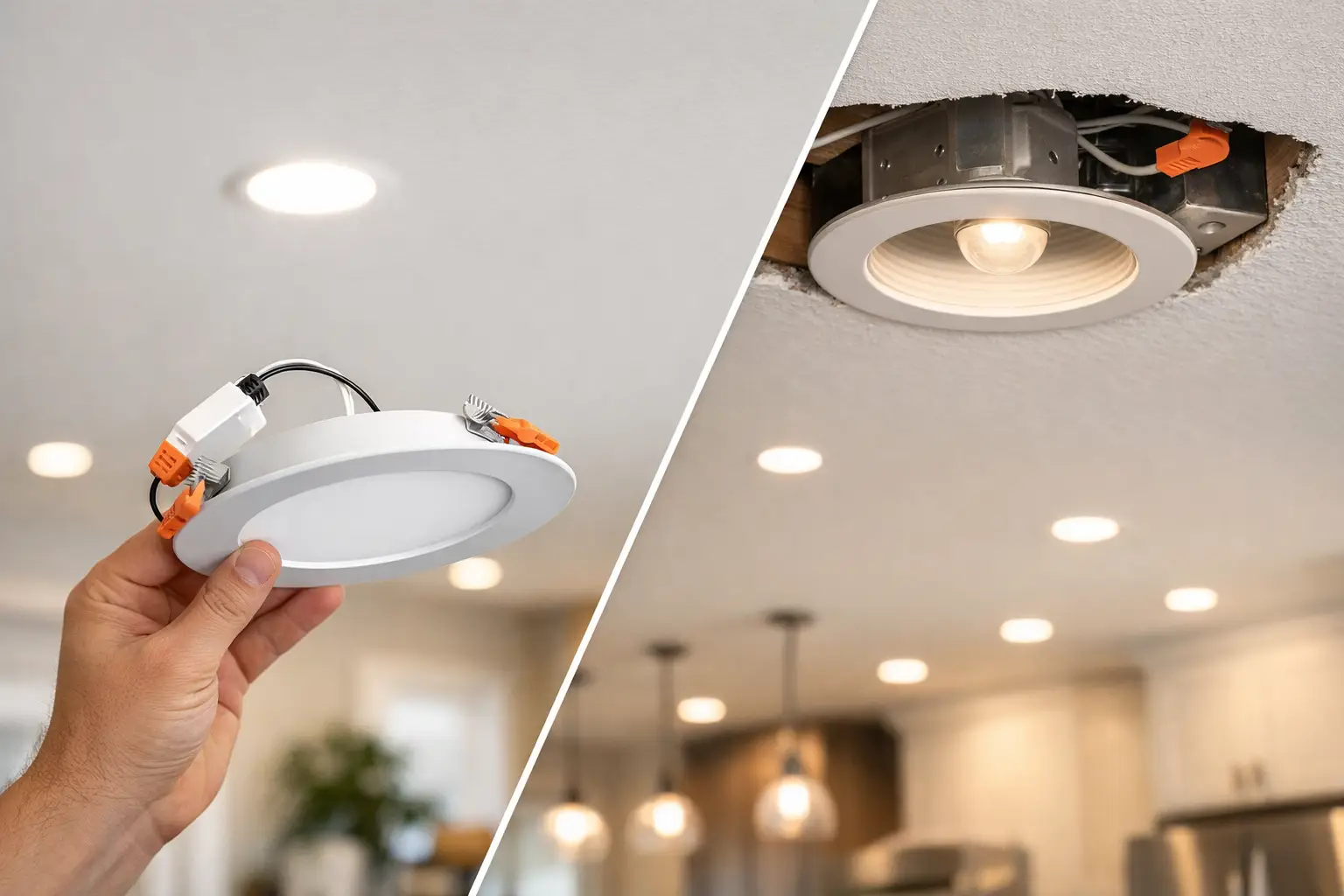
If you are weighing led canless vs recessed lights on a project timeline, this is rarely just a style decision. It affects labor hours, ceiling flexibility, maintenance planning, and the finish level your buyer or client notices the moment they walk in. For builders, designers, and investors, the right call can trim install friction without creating headaches at inspection or punch-out.
The short version is simple: canless LED fixtures usually win on speed, shallow ceiling conditions, and straightforward budgeting. Traditional recessed lights still make sense when you want component flexibility, easier access to replace trims or modules, or a more established spec for higher-end custom work. The best option depends on the ceiling, the scope, and how long you expect the property to perform before the next upgrade cycle.
LED canless vs recessed lights: what actually changes on-site?
On paper, both options create the same visual effect – light coming cleanly from the ceiling plane. On-site, they install and perform differently.
A traditional recessed light uses a housing, often called a can, installed above the ceiling. Then you add the light source and trim. In many older jobs, that meant more parts, more ceiling cavity requirements, and more coordination with framing, insulation, and duct runs. Newer integrated recessed systems have improved that process, but they still rely on a separate housing in many applications.
A canless LED fixture skips the traditional housing. It usually uses a thin fixture body and remote junction box, which makes it useful when joist space is tight or mechanicals are crowding the ceiling cavity. That design change is what saves time in many remodels and top-floor units.
For a GC or investor, the practical difference is less about appearance and more about friction. Canless products tend to reduce labor complexity. Recessed can systems tend to give you more modularity and, in some specs, a more familiar path for electricians and inspectors.
Where canless LEDs usually win
In flips, cosmetic remodels, and value-driven new construction, canless fixtures often come out ahead because they solve common field problems fast.
The first advantage is ceiling depth. If you are working under a low attic plane, below ductwork, or in a condo slab condition with limited drop space, a thin canless fixture can open up lighting locations that would be harder with a standard can. That matters in kitchens, basement finishes, and hallways where every inch counts.
The second advantage is install speed. Fewer parts typically means faster rough-in and trim-out. On a multi-room project, even modest time savings per fixture adds up. If your electrician can move quicker and cut fewer workarounds around joists and HVAC, your labor budget looks better.
The third advantage is budget clarity. Most canless LEDs are sold as integrated units, so your fixture cost is easier to estimate upfront. There is less mixing and matching of housing, trim, and lamp type. For builders trying to standardize a lighting package across several homes or units, that simplicity is useful.
There is also an air-sealing benefit in many models. Properly rated canless fixtures can help reduce unwanted air leakage compared with older recessed assemblies, especially in insulated ceilings. That is not a magic bullet for envelope performance, but it can support energy goals on tighter builds.
Where traditional recessed lights still make sense
Canless is not automatically the better spec. Traditional recessed lights still hold their ground in custom homes, layered lighting plans, and projects where future serviceability matters.
One reason is flexibility. With a recessed can system, you may have more trim options, beam spreads, and lamp choices depending on the line you spec. Designers who want tighter visual consistency across multiple ceiling conditions sometimes prefer that control. In a higher-end residence, that can matter more than shaving a little install time.
Another reason is maintenance planning. Integrated canless LEDs are convenient, but when the unit fails, you typically replace the whole fixture. With some recessed systems, you can replace a lamp, trim, or module independently. That can be helpful in long-hold rentals, large residential portfolios, or properties where maintenance teams want standardized service parts.
There is also the comfort factor. Some electricians simply prefer traditional recessed systems because they know exactly how they behave in different ceiling assemblies. That alone should not drive your spec, but it can affect field efficiency if your crew is moving fast and sticking to familiar products.
Cost, labor, and ROI
For most budget-sensitive projects, the led canless vs recessed lights decision comes down to total installed cost, not just fixture price.
Canless fixtures are often less expensive to install because they reduce steps and accommodate more ceiling conditions without extra framing adjustments. On a straightforward remodel, that can improve ROI quickly. If you are trying to modernize a dated property before listing, clean canless downlights can deliver the updated look buyers expect without creating a larger electrical scope.
Traditional recessed systems may cost more in labor and materials, especially if housings, trims, and lamps are all separate line items. But if the project requires a specific lighting effect or a long-term service strategy, that added cost may be justified.
The best way to evaluate ROI is by project type. In a flip, speed and visual cleanliness usually matter most. In a custom design-build, consistency, dimming performance, and trim options may carry more value. In a rental renovation, maintenance strategy might outweigh both.
Ceiling conditions that should drive the choice
This is where smart specs save rework.
If the ceiling cavity is shallow, crowded, or unpredictable, canless is usually the safer call. That includes older homes with irregular framing, basement remodels, and top-floor ceilings with insulation and vent conflicts. A thin-profile fixture gives your team more placement freedom and fewer surprises after drywall comes down.
If you have open access, generous cavity depth, and a premium lighting plan, recessed cans may be worth the extra effort. They also make sense when you need a specific aperture size or trim family to match the design intent throughout the home.
Wet and damp ratings matter too. Not every fixture belongs in every location. Bathrooms, covered exteriors, and shower zones need the correct rating, whether you go canless or recessed. The wrong spec here can create inspection issues and callback risk.
Light quality matters more than the fixture type
Many project teams get stuck debating canless versus can and overlook the specification details that buyers actually feel.
Color temperature is one of them. In most residential projects, 2700K to 3000K creates the safest result. It feels warm, current, and broadly marketable. Cooler light can work in utility areas, but in living rooms, kitchens, and primary suites, it often makes finishes feel harsher than intended.
Color rendering is another. A high CRI helps paint, wood tones, and countertops read accurately. That is especially important in staged listings and designer-led installs where material quality is part of the sale.
Then there is glare. A poor-quality canless fixture can feel harsh even if the install was fast. A poorly chosen recessed trim can do the same. Look at lensing, beam spread, dimming compatibility, and how the fixture sits in the ceiling plane. If the room is finished beautifully but the lighting feels cheap, the whole space loses value.
Best use cases by project type
For flips and light-to-mid remodels, canless LEDs are usually the best default. They install quickly, create an updated look, and help control labor. If the goal is to move a property faster with a clean, modern ceiling plan, spec these first.
For designer-driven renovations, the answer depends on the visual target. If the ceiling needs to disappear and the trim detail is minimal, canless may still work well. If the lighting plan is layered and exacting, traditional recessed systems may give you more control.
For long-hold rentals and multifamily turns, think beyond install day. If maintenance teams need easy part replacement and standardization, some recessed systems may be more practical. If unit turns need to happen fast with minimal ceiling disruption, canless may still be the better operational choice.
For new construction at scale, standardization is everything. Pick one path and build a repeatable spec package around it. That saves decision time, reduces ordering errors, and keeps your finish schedule tighter.
So which should you spec?
If you need the safest all-around answer for modern residential work, start with canless LED fixtures. They fit more ceiling conditions, usually cut labor, and deliver the streamlined look most buyers and clients expect.
Choose traditional recessed lights when design flexibility, serviceability, or trim-specific aesthetics are part of the brief. That is more common in custom homes, premium renovations, and projects where long-term maintenance planning is built into the budget.
The strongest spec is rarely the one with the most features. It is the one that fits the ceiling, the crew, and the exit strategy. If you are building a repeatable lighting package for flips, renos, or client installs, that is the standard worth keeping. For more practical sourcing and design guidance, Hudson Valley Review is built for exactly that kind of decision.







Leave a Reply