
A fan that looks great on a spec sheet can still fail on install day. Too small, and the room feels stuffy. Too large, and it overpowers the ceiling plane, crowds recessed lighting, or creates more visual weight than the design can handle. If you’re figuring out how to size ceiling fan for room conditions in a flip, model home, rental refresh, or client renovation, the goal is simple: match airflow, scale, and mounting height to the space you are trying to sell or live in.
For builders, designers, and investors, sizing is not just a comfort decision. It affects perceived finish quality, staging impact, and whether buyers read a room as thoughtfully designed or value-engineered in the wrong places. A properly sized fan can make a bedroom feel calmer, a great room feel finished, and a covered patio more usable. That is a small spec choice with outsized return.
Why ceiling fan sizing matters more than most specs
Ceiling fans sit at the intersection of function and sightline. Unlike a lamp or side table, they are always in view, and they directly affect comfort. That means the wrong size gets noticed twice – once visually and once physically.
In practical terms, an undersized fan will not move enough air to justify the install cost. An oversized fan may perform well, but if blade span is too aggressive for the room, it can make the ceiling feel lower and the layout feel cramped. In resale-focused projects, that balance matters. Buyers do not usually walk through saying, “Great CFM rating,” but they do notice when a bedroom feels cool and proportional.
There is also an efficiency angle. A correctly sized fan supports HVAC performance by improving air circulation, which can help spaces feel comfortable at slightly higher thermostat settings in summer and support destratification in winter. For investors holding rentals, that is a quiet operating benefit.
How to size ceiling fan for room dimensions
Start with square footage. This is the fastest way to narrow your blade span before you factor in ceiling height, furniture placement, or style.
For small rooms up to about 75 square feet, a 29- to 36-inch fan is usually enough. Think small offices, compact guest rooms, or laundry-adjacent flex spaces.
For rooms from 76 to 144 square feet, a 36- to 44-inch fan tends to fit best. This range works well for standard bedrooms, nurseries, and many secondary living spaces.
For rooms between 144 and 225 square feet, move into the 44- to 54-inch range. This is common territory for primary bedrooms, larger guest rooms, and many dining or living rooms.
For spaces above 225 square feet, a 52- to 60-inch fan is often the right starting point. Great rooms, open-plan living areas, and large covered patios typically fall here. In oversized rooms, one giant fan is not always the answer. Two medium fans often deliver better coverage and a cleaner visual rhythm than one oversized unit dropped into the middle.
That baseline gets you close. But pros know “close” is not the same as right.
Use room shape, not just square footage
A long narrow room and a square room with the same square footage will not always perform the same way. In a rectangular space, airflow distribution can feel uneven if you place one fan at the center and expect it to serve the entire footprint. This comes up often in open living-dining combinations and long bonus rooms.
If the room has distinct zones, treat those zones honestly. A seating area and dining area may each need their own fan or one fan plus decorative lighting, depending on layout and ceiling height. This is where design and mechanical thinking need to work together.
Check clearance before you finalize the spec
Leave enough space between blade tips and walls, cabinets, or tall millwork. A good rule is at least 18 inches from blade tip to wall, though more is better visually and functionally. Also keep fan blades clear of pendants, recessed cans, sprinklers, and beams.
On paper, a 60-inch fan may fit the square footage. In the field, that same fan may fight with a tray ceiling, shift the lighting layout, or sit too close to tall drapery lines. That is why final sizing should happen after reflected ceiling plan review, not before.
Ceiling height changes the answer
Room size is only half the calculation. Ceiling height determines how the fan should mount and whether the blade span will feel proportionate.
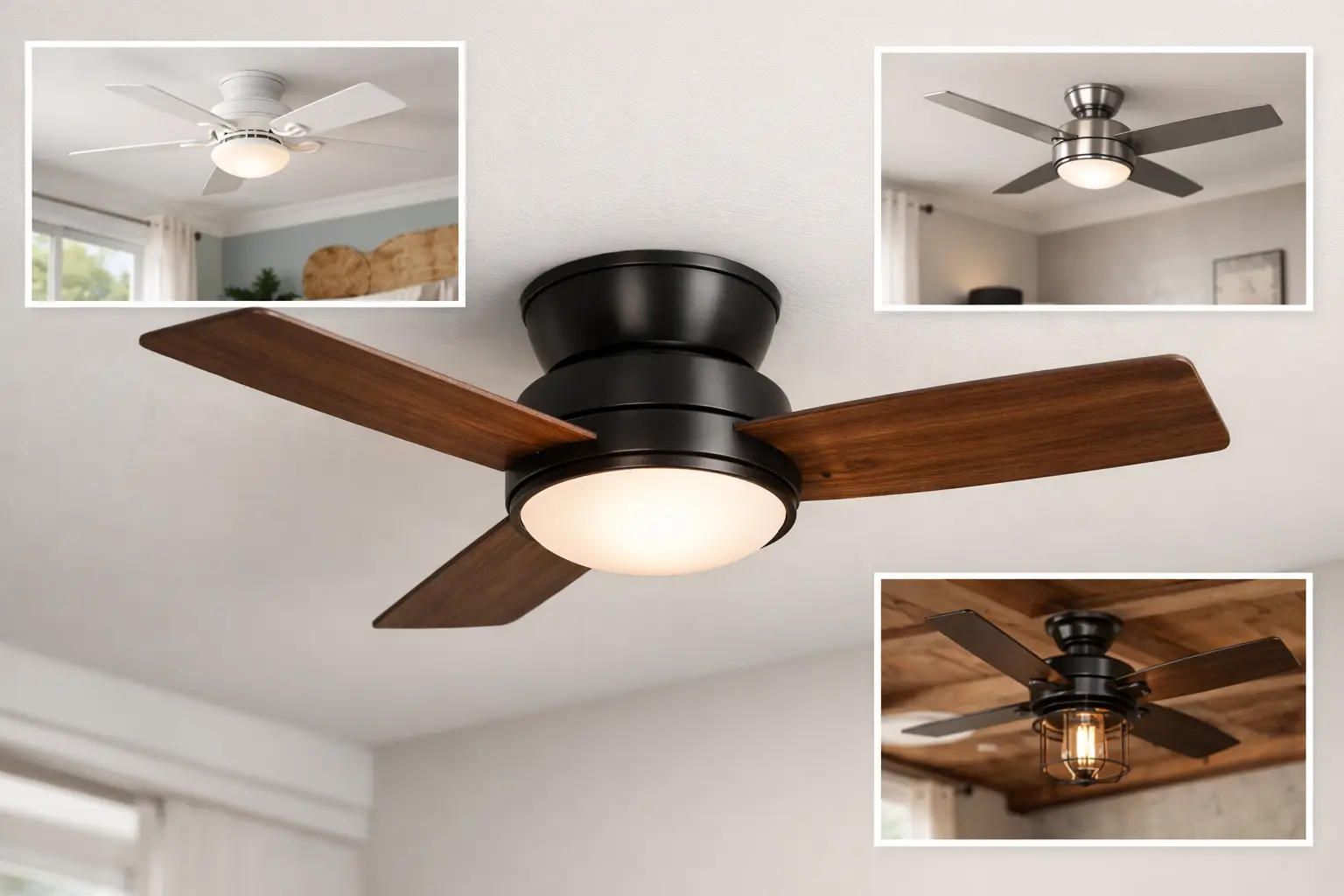
For standard 8-foot ceilings, a flush-mount or low-profile fan is usually the safest choice. You want the blades high enough for code and comfort while keeping the fixture from visually dropping into the room. In many builder-grade bedrooms, a low-profile 44- to 52-inch fan is the workhorse spec.
For 9-foot ceilings, you have more flexibility. A standard mount with a short downrod often looks more intentional than a tight flush unit, especially in updated or design-forward interiors. The fan gains presence without hanging too low.
For ceilings 10 feet and higher, use the downrod length to bring the fan closer to the occupied zone. If you leave the fan too close to a high ceiling, airflow at seating level can feel weaker than the CFM number suggests. In tall foyers and vaulted family rooms, this is a common miss.
The target is typically to keep blades about 8 to 9 feet above the floor. That gives you effective airflow while maintaining comfortable clearance.
Airflow, or CFM, is where performance shows up
Blade span gets most of the attention, but CFM – cubic feet per minute – tells you how much air the fan actually moves. For project work, CFM is a better performance filter than marketing language.
A larger blade span does not automatically mean better airflow. Blade pitch, motor quality, and housing design all matter. Two 52-inch fans can perform very differently. If a client wants a quiet bedroom fan or you are upgrading a flip where comfort is part of the sales strategy, compare CFM and efficiency, not just diameter.
As a general benchmark, smaller rooms can function well with lower CFM, while larger living spaces benefit from higher output. Covered outdoor areas often need more airflow than comparably sized interiors because open edges reduce the perceived breeze.
For pros, the takeaway is simple: size by room, then verify by CFM.
Style and scale still matter
This is where many otherwise smart installs go sideways. A fan is not just mechanical equipment. It is a visible finish, often at the center of the room.
In a compact bedroom, an oversized industrial fan can dominate the space even if the airflow is excellent. In a vaulted great room, a small basic fan can look like an afterthought. The right fan should relate to the ceiling plane, the furniture grouping, and the finish package.
Designers already know this instinctively, but it matters for ROI too. In a flip or rental, the fan often acts as a visual shorthand for the quality level of the whole property. Matte black can sharpen a modern spec. A soft brass or wood-tone blade can warm up a neutral room. The point is not to overspend. It is to avoid breaking the finish story with the wrong scale or finish.
Best practices by room type
Bedrooms usually perform best with 44- to 52-inch fans, depending on square footage. Prioritize quiet motors and integrated lighting only if the room truly needs the lumen output.
Living rooms and family rooms often land in the 52- to 60-inch range. In open layouts, think about furniture zones before assuming one central fan will do the whole job.
Dining rooms are trickier. A fan above a dining table can work, but only if ceiling height, table scale, and adjacent lighting all cooperate. In more formal dining spaces, a decorative fixture may still be the better design move.
Covered patios need damp- or wet-rated fans sized generously enough to offset open-air conditions. This is one area where undersizing gets exposed fast.
Common sizing mistakes that cost time and money
The first mistake is choosing by look alone. A fan can match the finish palette and still be wrong for the room.
The second is ignoring ceiling height. Even a well-sized fan will underperform if mounted too high in a vaulted space or hang awkwardly low in a standard-height bedroom.
The third is treating open-concept square footage as one zone. If the room functions as multiple spaces, your airflow plan should too.
The fourth is skipping plan coordination. Fan sizing should happen alongside lighting layout, HVAC registers, and ceiling details. That one conversation can prevent rework and keep install crews moving.
A practical spec approach for faster decisions
If you need a repeatable process, start with room square footage, then confirm ceiling height, then review CFM, then pressure-test the visual scale against the reflected ceiling plan and finish package. That order keeps the decision practical without losing the design intent.
For teams handling multiple units or fast-turn renovations, build a short approved fan matrix by room type. One option for secondary bedrooms, one for primary suites, one for living areas, and one for covered exterior use. That cuts decision time while keeping the project coherent. It is the kind of systems thinking that saves hours across a full pipeline.
Hudson Valley Review readers tend to work where speed matters, but speed only helps when the spec is right the first time. A well-sized ceiling fan does more than move air. It supports comfort, sharpens the room’s proportions, and helps the finished space read as intentional. Spec these with the same care you give flooring and lighting, and the room will carry its weight on day one and at resale.







Leave a Reply